
A GenerLink and a transfer switch both let you power your home’s circuits from a portable generator safely, without backfeeding the grid. The difference is where they go. A GenerLink mounts behind your electric meter and is installed by your utility in under an hour. A traditional transfer switch mounts next to your breaker panel and needs an electrician. If your utility offers GenerLink, it’s usually the easiest option. If it doesn’t, a manual transfer switch or an interlock kit is the way to go.
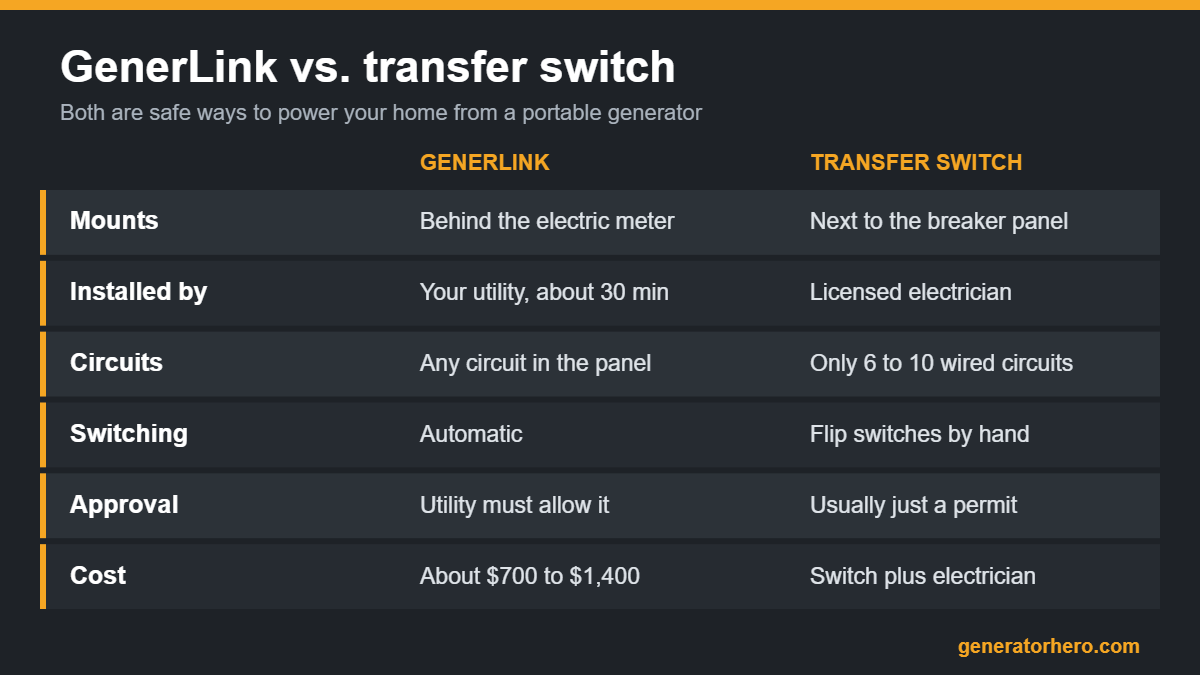
GenerLink vs. transfer switch at a glance
| GenerLink | Manual transfer switch | Interlock kit + inlet | |
|---|---|---|---|
| Where it goes | Between the meter and meter socket | Next to the breaker panel | On the breaker panel, plus an outdoor inlet box |
| Who installs it | Your utility (or an approved electrician) | Licensed electrician | Licensed electrician |
| Typical cost | About $700 to $1,400 installed, or a monthly lease ($8 to $25) | Several hundred dollars for the switch, plus an electrician | Often the cheapest: a low-cost kit plus an electrician |
| Circuits you can run | Any circuit in the panel, up to the generator’s capacity | Only the 6 to 10 circuits wired to the switch | Any circuit in the panel, up to the generator’s capacity |
| Switching over | Automatic when you start the generator | Flip the switches by hand | Flip the main breaker off, slide the interlock, turn on the generator breaker |
| Needs utility approval | Yes | No (needs a permit in most areas) | No (needs a permit in most areas) |
| Generator limit | Up to 9,600 running watts (40A model) | Depends on the switch (30A or 50A) | Depends on the inlet and breaker |
How a GenerLink works
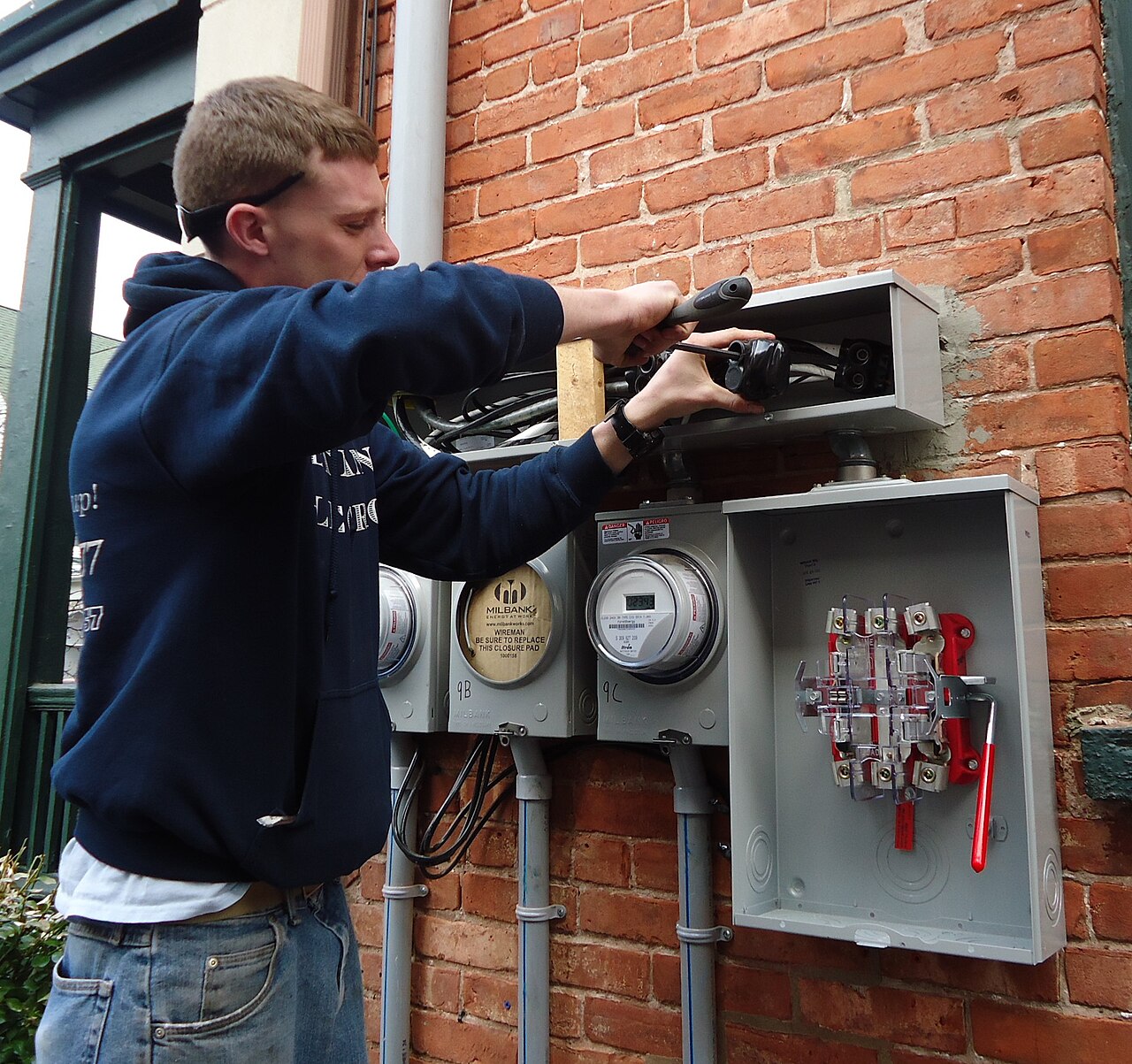
GenerLink is made by Global Power Products. Your utility pulls the meter, plugs the GenerLink into the meter socket, and plugs the meter back into the front of it. A short cord (20 feet is standard) runs from the GenerLink to your generator’s 4-prong 120/240V outlet.
When the GenerLink senses power coming from the generator, it disconnects your house from the utility lines. When grid power returns and you shut the generator off, it switches back. Because the whole panel is connected, you choose what to run by turning breakers on and off, and you have to keep the load within what your generator can handle.
Two sizes are common:
- 30 amp for generators with an L14-30 outlet, up to about 7,200 running watts
- 40 amp for generators with a 14-50 outlet, up to 9,600 running watts
How a traditional transfer switch works
A manual transfer switch is a small subpanel wired next to your main panel. An electrician moves your most important circuits (furnace, fridge, well pump, a few lights) onto it. During an outage you plug the generator into an inlet box outside, then flip each circuit on the switch from “Line” to “Gen.” Read more in how a generator transfer switch works.
If GenerLink isn’t an option where you live, Ace Hardware carries Reliance Controls manual transfer switches and inlet boxes for an electrician to install. (We may earn a commission if you buy through these links.)
Pros and cons
GenerLink
- Pros: fast install with no rewiring, the utility handles it, built-in surge protection on many models, automatic switching, and many utilities let you lease or finance it on your bill.
- Cons: only works if your utility allows it, limited to 200-amp single-phase service, often not allowed with grid-tied solar, and the price is higher than an interlock kit.
Manual transfer switch
- Pros: works anywhere, no utility approval, and it’s hard to overload because only selected circuits are connected.
- Cons: needs an electrician and a permit, you’re limited to the circuits wired to it, and switching over is manual.
Interlock kit
- Pros: usually the cheapest code-compliant option, and you can run any circuit.
- Cons: needs an electrician, a kit made for your exact panel, and an inlet box. You have to manage the load yourself.
Which one should you get?
- Get a GenerLink if your utility offers it, you have 200-amp service or less, and you want the simplest install. Check the list of utilities that offer GenerLink.
- Get a manual transfer switch if your utility doesn’t allow GenerLink, or you have a smaller generator and only need a handful of circuits.
- Get an interlock kit if you want the lowest cost and you’re comfortable managing breakers during an outage.
All three are safe when installed correctly. The one thing you should never do is backfeed through a dryer or wall outlet. Here’s why backfeeding is dangerous, plus every safe way to connect a generator to your home.
FAQ
Is a GenerLink a transfer switch?
Yes. It’s a meter-mounted transfer switch, listed to the UL 1008M standard for meter-mounted transfer switches.
How much does a GenerLink cost?
Most utilities charge about $700 to $1,400 installed, or lease it for about $8 to $25 a month. GenerLink’s own store lists it at $999. See our full GenerLink cost breakdown.
Will my generator work with a GenerLink?
It needs a 4-prong 120/240V L14-30 or 14-50 outlet and can’t have a full-GFCI panel. Here’s how to tell if your generator is compatible.
Can I use a GenerLink with a home standby generator?
No. GenerLink is for portable generators. Home standby generators use an automatic transfer switch.