
A generator works with a GenerLink if it has a 4-prong 120/240-volt outlet (an L14-30 twist-lock or a 14-50), stays under about 9,600 running watts, and doesn’t have a full GFCI panel. That covers most mid-size portable generators from around 5,000 to 10,000 watts. Small inverter generators with only 120V outlets won’t work, and neither will home standby generators.
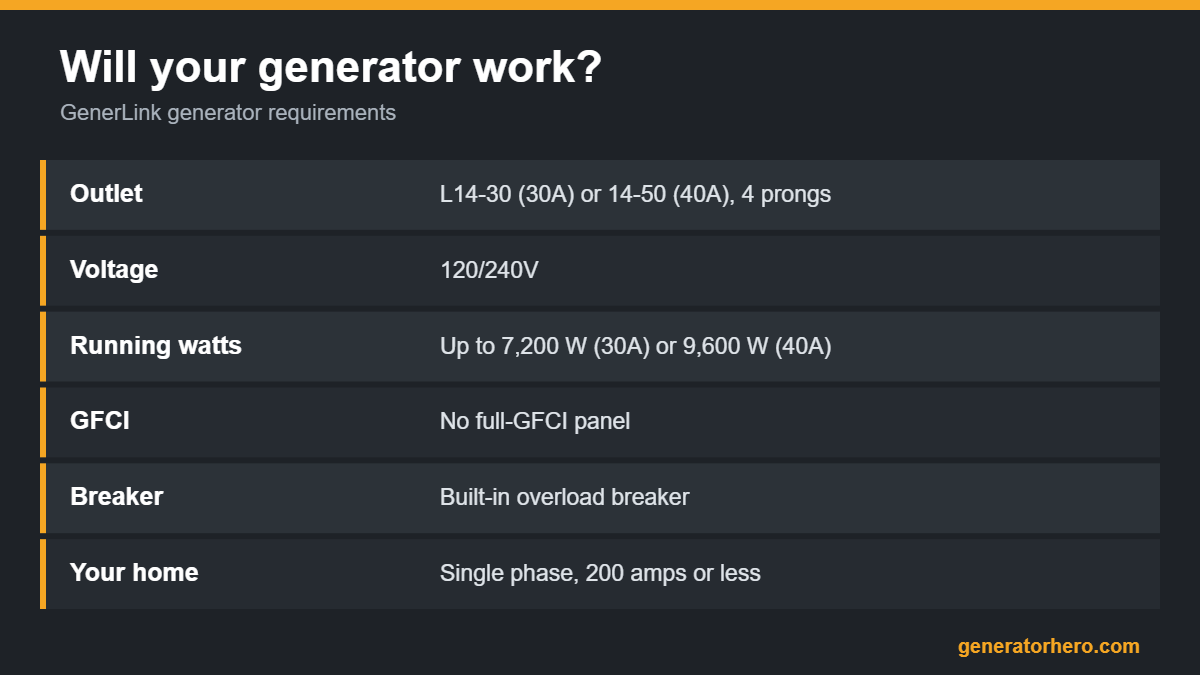
GenerLink generator requirements
| Requirement | What you need |
|---|---|
| Voltage | 120/240V |
| Outlet | 4-prong (4-wire): L14-30 for the 30A GenerLink, 14-50 for the 40A GenerLink. Some utilities also accept L14-20. |
| Running watts | Up to about 7,200 W on the 30A model and 9,600 W on the 40A model |
| GFCI | No full-GFCI panel. Generators where every outlet is GFCI protected aren’t compatible. |
| Breaker | A built-in overload circuit breaker |
| Your home | Single-phase service of 200 amps or less |
A larger generator can still connect, but the GenerLink limits what you can use to its rating, so you won’t get the generator’s full output.
How to check your generator in 3 steps
- Look at the outlets. Find a round twist-lock outlet labeled “L14-30” or “120/240V 30A,” or a large 50-amp outlet labeled “14-50.” It must have four slots.
- Check the running watts on the label or in the manual. Running watts are lower than starting (peak) watts.
- Check for GFCI. If every outlet, including the 240V one, has GFCI protection, it isn’t compatible. Many jobsite generators are built that way.
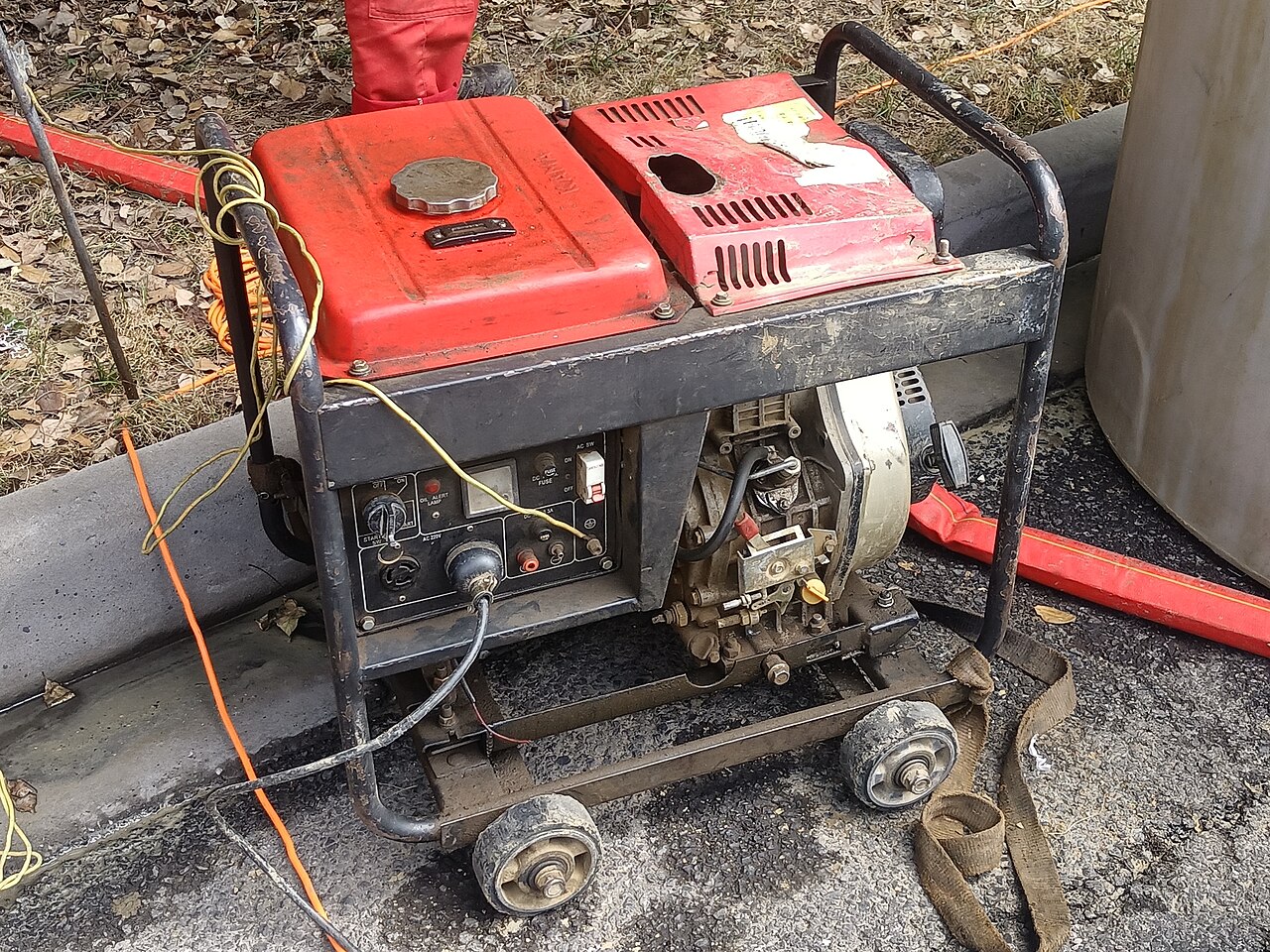
Outlets that won’t work
- 120V-only outlets, like the household-style outlets on small inverter generators
- 3-prong 120/240V outlets (like the older 10-30 or L10-30), which don’t have a separate neutral
- Straight-blade 14-30 outlets are not accepted by some utilities
- 240V-only outlets
- Outlets rated over 50 amps
Which GenerLink size do you need?
| Your generator | GenerLink model |
|---|---|
| L14-30 outlet, up to about 7,200 running watts | 30 amp (MA23) |
| 14-50 outlet, up to 9,600 running watts | 40 amp (MA24) |
Not sure what size generator you need? Our guides on what a 7,500-watt generator can run and what a 3,500-watt generator can run will help you figure out your load.
Bonded or floating neutral?
GenerLink’s older compatibility guides list both bonded-neutral and floating-neutral generators as compatible. Your utility checks this at installation. Many utilities, like GRU and Clay Electric, ask you to have the generator there when they install the GenerLink so they can test it.
Inverter and dual-fuel generators
Larger inverter and dual-fuel generators often have an L14-30 or 14-50 outlet, so many of them work. What matters is the outlet, the voltage and the GFCI setup, not the engine or fuel type. Small inverter generators under about 4,000 watts usually only have 120V outlets, so they won’t work.
Using your generator safely with a GenerLink
- Run the generator outside, at least 20 feet from the house, never in a garage. See how far a generator should be from your house.
- Turn off most breakers before starting the generator, then turn circuits on one at a time to stay within its capacity.
- Use only the GenerLok cord that came with the GenerLink.
- Test the setup every month or so, so you know it works before a storm. Here’s how long you can run a generator continuously.
FAQ
Can I use a 3,500-watt generator with a GenerLink?
Only if it has a 4-prong 120/240V outlet. Many generators that small only have 120V outlets, so check yours first.
Can I use an EV or a power station with a GenerLink?
Some portable power stations and trucks have a 120/240V outlet that fits, but check with your utility and GenerLink first. Utilities mainly test with gas, propane and dual-fuel portable generators.
Can I use a home standby generator?
No. GenerLink is for portable generators. Standby generators use their own automatic transfer switch.
Requirements are from GenerLink’s compatibility guides and utility program pages (GRU, DTE Energy, Central Electric Cooperative, Jackson County REMC, Clay County Electric Cooperative), checked in October 2026. Your utility may have extra rules.