
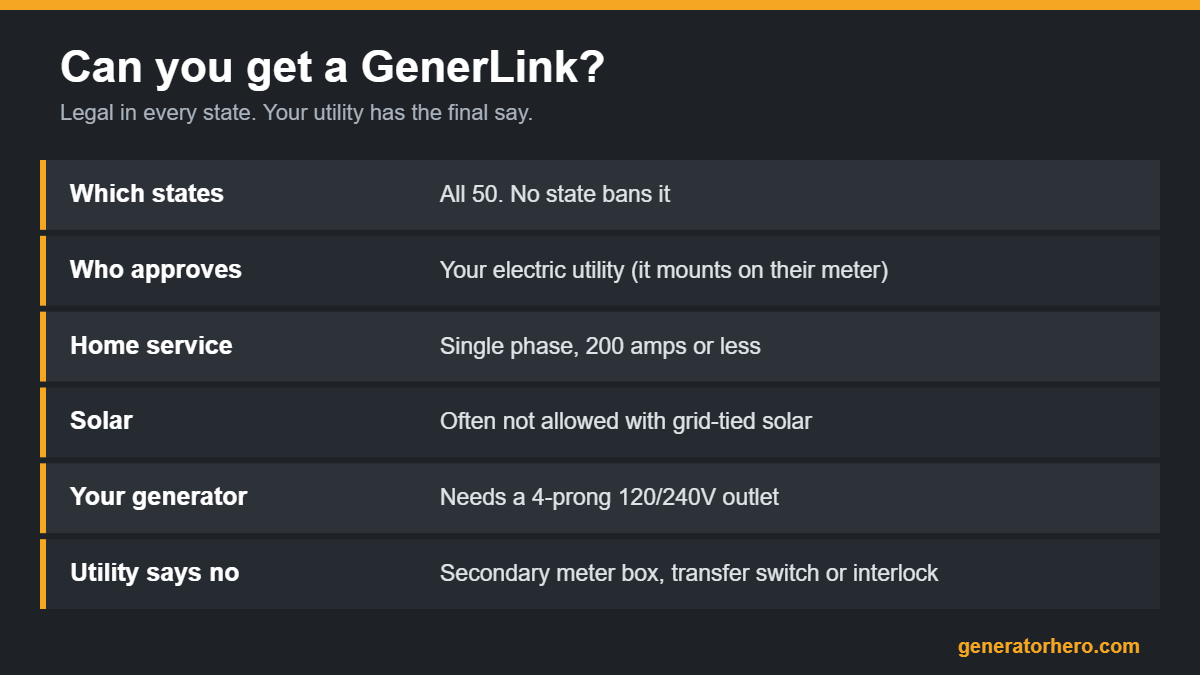
GenerLink is legal in every U.S. state. No state bans it. Your electric utility decides whether you can have one, because it mounts on the utility’s meter. Many electric co-ops, public power districts and city utilities sell or lease GenerLink and install it for you. Some large utilities don’t allow it. The fastest way to find out is to search your utility’s website for “GenerLink” or call them.
Why it’s up to your power company, not your state
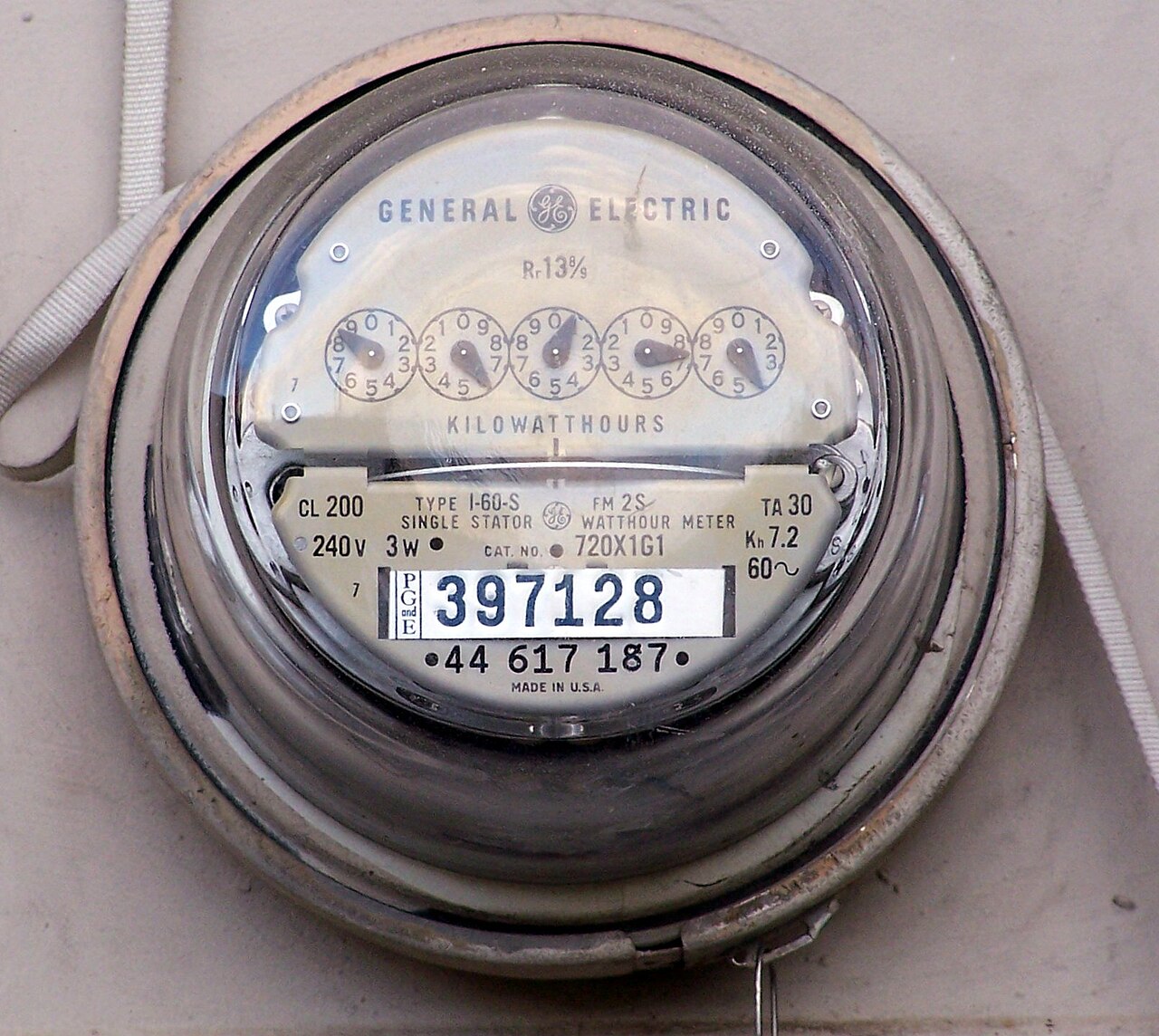
A GenerLink is a transfer switch that sits between your electric meter and the meter socket on the side of your house. The meter and its seal belong to the utility, so they have to approve anything installed there. That’s why approval varies from one power company to the next, even inside the same state.
A few things can rule you out even when your utility does allow GenerLink:
- Service size: GenerLink is made for single-phase homes with 200-amp service or less. 320/400-amp, three-phase and CT-metered services aren’t eligible.
- Solar: Some utilities, like LCEC in Florida and Columbia River PUD in Oregon, won’t install it on homes with grid-tied solar. Others, like Gainesville Regional Utilities, require you to switch the solar off while the generator runs.
- Multi-unit buildings: Apartments and condos with shared meter banks usually can’t use one.
- Your generator: It needs a 4-prong 120/240V outlet. See which generators work with a GenerLink.
Utilities that offer GenerLink (2026)
These utilities have GenerLink programs on their own websites. Prices are what each utility lists and usually include installation. We checked them in October 2026, but prices change, so confirm with your utility.
| State | Utility | What it costs |
|---|---|---|
| Alabama | Baldwin EMC | $725 (30A) or $825 (40A) plus tax, installed; 12 or 24 months interest-free |
| Alabama | Riviera Utilities | $1,196.40 (30A) or $1,379 (40A) plus tax, installed |
| Arkansas | First Electric Cooperative | $806.25 or $967.50 installed; $200 down and 12 months interest-free |
| Arkansas | Arkansas Valley Electric Cooperative | $690.64 to $884 installed (2021 prices) |
| Arkansas | Clay County Electric Cooperative | Call your local office |
| Florida | Gainesville Regional Utilities (GRU) | $1,034.25 plus tax, installed |
| Florida | Clay Electric Cooperative | $1,135 plus tax (40A with surge protection), installed |
| Florida | Lee County Electric Cooperative (LCEC) | Offered; see LCEC’s GenerLink page |
| Florida | SECO Energy | Offered; see SECO’s GenerLink page |
| Michigan | DTE Energy (Surge Protection Plus) | $22.99 a month plus a $99.99 (30A) or $249.99 (40A) install fee |
| Nebraska | Southern Public Power District | $7.75 a month on a 24-month lease, $150 cord deposit |
| New York | Steuben Rural Electric Cooperative | $728 (30A) or $853 (40A) plus tax, free install |
| Oklahoma | Lake Region Electric Cooperative | $939.69 installed, or $25 a month with a contract |
| Oregon | Midstate Electric Cooperative | $948.75 (30A) or $1,091.75 (40A), free install |
| Oregon | Columbia River PUD | $11 a month rental, 12-month minimum |
| Pennsylvania | Central Electric Cooperative | $774 to $986 including tax and installation |
| Virginia | Community Electric Cooperative | $12.75 (30A) or $13.75 (40A) a month on a 36-month lease, $50 fee |
| Washington | Ferry County PUD | Call the PUD |
This list isn’t complete. Hundreds of co-ops and municipal utilities offer GenerLink, so if yours isn’t here, check its website. For a full breakdown of buying vs. leasing, see how much a GenerLink costs.
Is GenerLink approved in Texas?
Texas doesn’t ban GenerLink, but it depends on who delivers your power. When we asked GenerLink in summer 2022, they told us Oncor (Dallas area) and CenterPoint (Houston) didn’t allow it. Several Texas electric co-ops have allowed it, so if you’re served by a co-op, ask them directly.
Utilities that haven’t allowed GenerLink
In summer 2022, GenerLink told us these utilities did not approve it. Policies change, so treat this as a starting point and check with the utility:
- FirstEnergy in Northeast Ohio
- PG&E in Northern California
- Oncor in the Dallas area
- CenterPoint in Houston
- ComEd in the Chicago area
How to check if your utility allows GenerLink
- Search your utility’s website for “GenerLink” or “meter-mounted transfer switch.”
- Call customer service and ask if they allow a GenerLink or another meter collar transfer switch, and whether they install it.
- Check GenerLink’s site. The maker, Global Power Products (800-886-3837), keeps an approval lookup on its store at shopgenerlink.com.
What if your utility says no?
- A secondary meter box. GenerLink’s FAQ says it can be installed in a second meter socket after the utility meter, by a licensed electrician. Check your local code first.
- A traditional transfer switch next to your breaker panel. See how a transfer switch works and our GenerLink vs. transfer switch comparison.
- An interlock kit and inlet box, installed by an electrician. It’s often the cheapest legal option.
Whatever you pick, never plug a generator into a wall outlet with a “suicide cord.” It can backfeed the grid and electrocute line workers. Some states have made backfeeding illegal: Alabama passed a law in 2022 making it unlawful to knowingly connect a generator in a way that backfeeds the grid. Here’s why backfeeding is dangerous and the safe ways to connect a generator to your home.
Related guides: How to Ground a Generator and How Far Should a Generator Be From Your House.
FAQ
Is GenerLink legal in all 50 states?
Yes. No state law bans it. Your utility has to approve it because it attaches to their meter.
Does GenerLink require a permit?
When the utility installs it behind its own meter, usually no. Gainesville Regional Utilities, for example, says there are no permit fees. If an electrician installs one in a secondary meter box, local permit rules apply.
Can I install a GenerLink myself?
No. It goes behind the utility’s sealed meter, so the utility or a licensed electrician approved by the utility has to install it.
Does GenerLink work with solar panels?
Often not. Some utilities won’t install it on homes with grid-tied solar, and others require the solar to be off while the generator runs.
Utility programs and prices were checked on each utility’s website in October 2026. Prices and policies change, so confirm with your utility before you buy.
Rick or Chad,
How likely is it that Austin Energy in Austin Texas will approve the Generlink?
To be sure you would have to contact generlink at (800)886-3837
Robert, did you find out if Austin Energy approves the Generlink ?
Anyone know if Encor of Texas, the power provide for the Fort Worth Area will allow this device to be installed?