
A generator power inlet box is an outdoor, weatherproof plug on the side of your house that your generator cord plugs into. It’s wired to a transfer switch or an interlock kit at your electrical panel, so the generator can stay outside while it powers your circuits. Match the inlet to your generator’s biggest outlet: most portables need a 30-amp L14-30 inlet, and larger ones use a 50-amp CS6375. The box itself costs about $20 to $100, according to HomeGuide, and an electrician should install it.
What a power inlet box does
You can’t safely run an extension cord through a window into your panel, and you should never plug a generator into a wall outlet. The inlet box is the safe connection point. Ferguson’s power inlet box guide describes it as working “like an electrical outlet for a house,” except power flows in instead of out.
A typical setup looks like this:
- The generator runs outside, at least 20 feet from the house, as the CPSC recommends.
- A generator cord runs from the generator’s twist-lock outlet to the inlet box.
- Wires inside the wall run from the inlet box to a transfer switch or to a backfeed breaker locked by an interlock kit.
- You flip the switch or breakers to move chosen circuits from utility power to the generator.
An inlet box does nothing on its own. It always has to feed a transfer switch or an interlock, which keeps your generator from backfeeding the utility lines. Here’s why backfeeding is dangerous.
Which inlet box do you need?
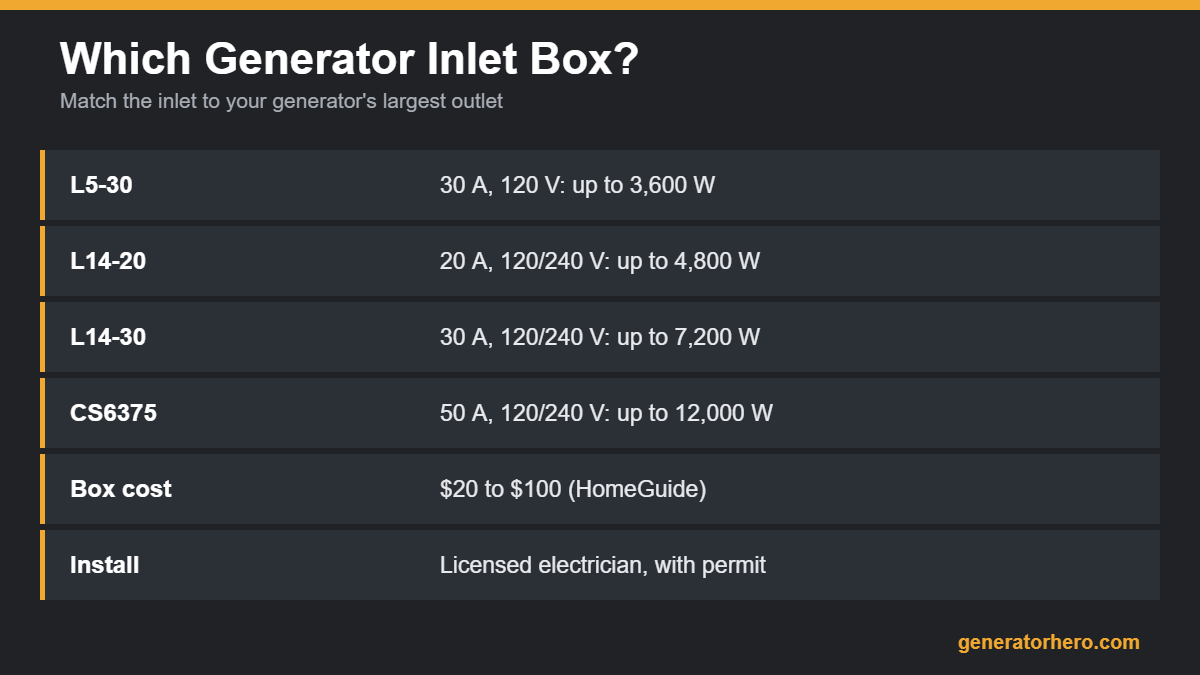
The inlet must match the plug type and amp rating of your generator’s outlet, your cord and your transfer switch. Ferguson’s guide says “the inlet box amperage must match that of the power cord and transfer switch.” These are the common types in the Reliance Controls lineup:
| Inlet | Rating | Fits | Max power (amps x volts) |
|---|---|---|---|
| L5-30 | 30 A, 125 V (3-prong) | Generators with only a 120 V 30 A outlet | 3,600 W |
| L14-20 | 20 A, 125/250 V | Small 240 V generators | 4,800 W |
| L14-30 | 30 A, 125/250 V (4-prong) | Most portables, about 5,000 to 8,000 W | 7,200 W |
| CS6375 | 50 A, 125/250 V | Large portables, about 10,000 W and up | 12,000 W |
The last column is simple math (amps times 240 or 120 volts), so it’s the most the connection can carry, not what your generator makes. Check your generator’s panel: if it has a 4-prong twist-lock marked L14-30, buy an L14-30 inlet and an L14-30 generator cord. If you might upgrade to a bigger generator later, ask your electrician whether a 50-amp inlet and switch make sense now.
Metal or nonmetallic?
Both work outdoors. Reliance’s PB series is metal and its PBN series is nonmetallic. The Reliance Controls PBN30 is high-impact ABS plastic with “a weather-resistant cover and a NEMA 3R rating,” and the metal PB50 is also NEMA 3R with a spring-loaded cover. NEMA 3R means the enclosure is made for outdoor use and resists rain. Nonmetallic boxes don’t rust and are lighter; metal boxes are tougher if the wall gets bumped by a mower or a car.
Where to mount the inlet box
Ferguson says an electrician usually installs the inlet “on the side of the house near the main electrical panel,” which keeps the wire run short. A few things to plan for:
- Generator placement. The generator has to sit at least 20 feet from the house, away from windows, doors and vents, so pick an inlet spot where that’s possible on a flat, dry area. See how far a generator should be from your house.
- Cord length. A longer cord needs thicker wire. Use our extension cord gauge calculator to check the size for your cord length.
- Height and access. Mount it where you can reach it in the dark and in snow, and where the cord won’t be a tripping hazard.
- Inside the wall. Some inlets connect through the wall straight into a transfer switch or panel. Others connect through a short conduit run.
How much does a power inlet box cost?
According to HomeGuide, a power inlet box costs $20 to $100 and a heavy-duty generator cord $30 to $350. Most people install the inlet as part of a transfer switch or interlock job, so it’s rarely priced alone:
| Item | Typical cost |
|---|---|
| Power inlet box | $20 to $100 |
| Generator cord (L14-30 or 50 A) | $30 to $350 |
| Interlock kit, installed with inlet | $400 to $850 |
| Manual transfer switch, installed | $400 to $1,300 |
| Electrical permit | $50 to $350 |
All figures are HomeGuide’s averages. See the full breakdown in our guide to transfer switch cost.
Can you install a generator inlet box yourself?
Mounting the box is easy. The rest is not: it involves running wire into your main panel, adding a breaker, and connecting it to a transfer switch or interlock, which usually requires a permit and an inspection. Reliance describes its inlet boxes as a connection point for “a qualified installer.” Hire a licensed electrician. Once it’s in, here’s how to connect and run your generator through it and how grounding works with a transfer switch.
Related guides: How to connect a generator to your house, Interlock kit vs. transfer switch, How a transfer switch works and GenerLink vs. transfer switch.
FAQ
What size inlet box do I need for my generator?
Match the inlet to your generator’s largest outlet. A generator with a 4-prong L14-30 outlet needs a 30-amp L14-30 inlet; one with a 50-amp outlet needs a 50-amp inlet, such as a CS6375, and a matching 50-amp cord.
Does a power inlet box need a transfer switch?
Yes. The inlet must feed a transfer switch or an interlocked backfeed breaker. Without one, the generator could backfeed the utility lines.
Is a metal or plastic inlet box better?
Both are made for outdoor use. Reliance’s metal PB and nonmetallic PBN boxes are both NEMA 3R rated. Plastic won’t rust; metal stands up better to bumps.
How far should the inlet box be from the generator?
The inlet can be anywhere on the wall, but the generator must sit at least 20 feet from the house, so plan for a cord long enough to reach, sized for that length.