
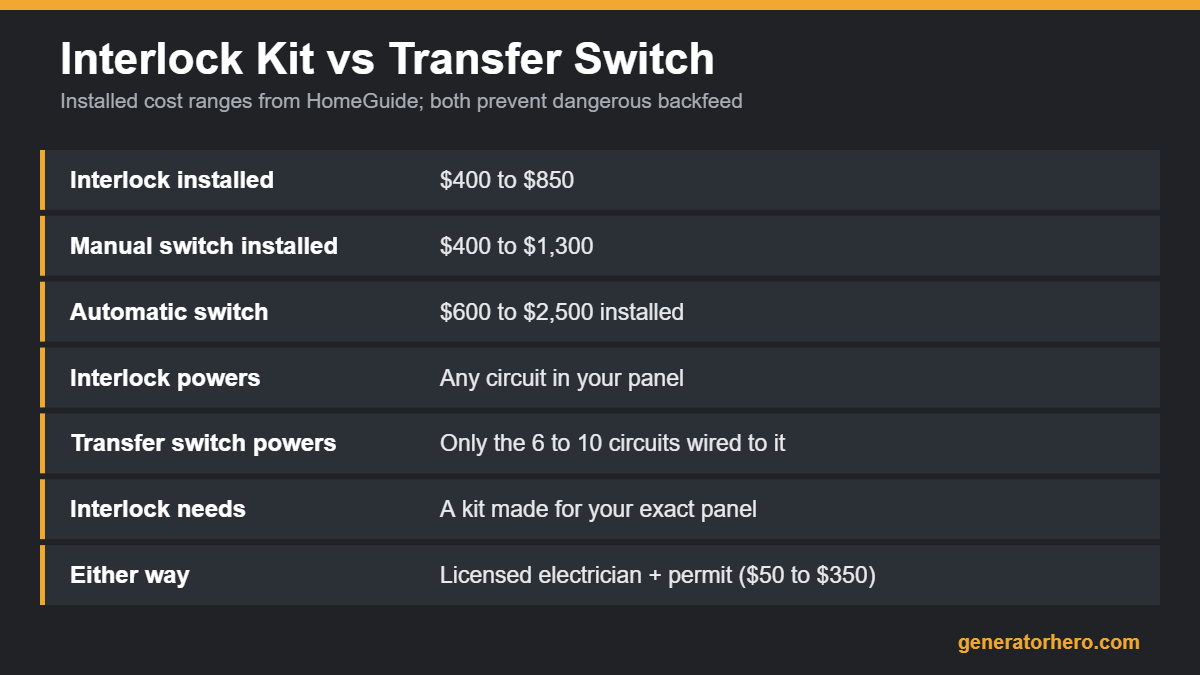
An interlock kit is the cheapest safe way to run your house on a portable generator: about $400 to $850 installed, versus $400 to $1,300 for a manual transfer switch, according to HomeGuide. An interlock lets you power any circuit in your panel, but you have to switch breakers by hand. A transfer switch costs more and powers only the circuits wired to it, but it’s simpler to use and works with almost any panel.
Both do the same critical job: they make it impossible for your generator and the utility to feed your house at the same time. That stops dangerous backfeed onto the power lines, which can kill line workers, and protects your generator when the power comes back. Plugging a generator into a wall outlet with a “suicide cord” does neither. See is it safe to backfeed a generator?
Interlock kit vs transfer switch at a glance
| Interlock kit | Manual transfer switch | |
|---|---|---|
| Typical cost installed | $400 to $850 | $400 to $1,300 |
| Part cost alone | $50 to $150 | $200 to $800 |
| Circuits you can power | Any circuit in the panel | Only the 6 to 10 circuits wired to it |
| How you switch over | Main breaker off, slide plate, generator breaker on, then pick circuits | Flip the switches on the transfer switch |
| Panel requirements | Kit must be made for your panel brand and model, with space for a backfeed breaker | Works with almost any panel |
| Risk of overload | Higher: easy to turn on too much | Lower: limited to the circuits you chose |
| Needs a power inlet box | Yes | Usually (or a pre-wired cord) |
How a generator interlock kit works
An interlock is a metal plate screwed onto your main electrical panel. It covers the main breaker and a “backfeed” breaker that your generator feeds through, and it slides so only one of them can be on at a time. To switch to generator power, you turn off the main breaker, slide the plate, turn on the generator breaker, and then turn on only the circuits you need.
The generator connects to an outdoor power inlet box, which is wired to that backfeed breaker. Because the backfeed breaker is fed from the generator side, it also needs a hold-down (retaining) kit so it can’t be pulled loose while energized. Eaton’s BR interlock bulletin, for example, says its kit is UL 67 listed for Eaton BR load centers, “meets NEC Article 702,” and includes the interlock, a hold-down kit and new labels.
The catch: an interlock has to match your exact panel. A kit for one brand or model won’t fit another, and some panels don’t have a kit at all, or don’t have a free slot next to the main breaker for the backfeed breaker.
How a manual transfer switch works
A manual transfer switch is a small subpanel mounted next to your main panel. An electrician moves 6 to 10 important circuits (fridge, furnace, well pump, a few lights and outlets) into it. Each circuit gets its own switch to pick “line” or “generator,” and you flip them over when the power goes out. Our guide to how a generator transfer switch works explains manual and automatic switches in more detail.
Because only the circuits you chose can run on the generator, it’s hard to overload a small generator by accident. The trade-off is that you can’t power a circuit that isn’t wired to the switch without hiring an electrician again.
What each option costs
HomeGuide breaks an interlock job down like this:
- Interlock kit: $50 to $150
- Supplies (breaker, inlet box, cord, wire): $200 to $400
- Labor: $150 to $300
- Total installed: $400 to $850
A manual transfer switch runs $200 to $800 for the part and $400 to $1,300 installed, and an automatic transfer switch (usually for a standby generator) runs $600 to $2,500 installed. Electricians charge about $50 to $130 an hour plus a call-out fee, and an electrical permit adds $50 to $350, per HomeGuide. If your utility allows it, a meter-socket adapter like GenerLink is another option: see how much GenerLink costs and GenerLink vs a transfer switch.
Which one should you get?
Choose an interlock kit if:
- A listed kit exists for your exact panel and there’s room for a backfeed breaker.
- You want to choose any circuit during an outage, like the water heater one day and the dryer the next.
- You have a generator of 5,000 watts or more and you’re comfortable managing the load.
- You want the lowest cost.
Choose a transfer switch if:
- Your panel has no listed interlock or no free space.
- Other people in your home will run the generator and you want it simple.
- You have a smaller generator and want to make overloading it hard.
- You may add a standby generator later (then go with an automatic switch).
Not sure how big a generator you need for the circuits you want? Use our generator size calculator.
Rules for either option
- Hire a licensed electrician and pull a permit. Both options change your main panel, and your inspector and homeowner’s insurance will expect it done to code.
- Keep the generator outside, at least 20 feet from the house with the exhaust pointed away. Use our cord gauge calculator to size the cord to the inlet box.
- Ground it correctly. Follow your generator’s manual and your electrician on grounding and neutral bonding. See how to ground a portable generator.
- Follow the switch-over order every time: main off before generator breaker on, and generator breaker off before main back on.
Related guides: How to connect a generator to your house, How a transfer switch works and GenerLink cost.
FAQ
Is a generator interlock kit legal?
In most places, yes, when it’s a kit listed for your panel and installed with a permit. Interlocks like Eaton’s are listed to UL 67 and made to meet NEC Article 702. Some local inspectors have their own rules, so ask your electrician or building department.
Is an interlock kit as safe as a transfer switch?
Both prevent backfeed when installed and used correctly. The interlock relies on you following the breaker order, and it lets you overload the generator more easily, so a transfer switch is more foolproof.
Can I install a generator interlock kit myself?
The kit itself screws on, but the job also involves a backfeed breaker, an inlet box and wiring inside the main panel. Hire a licensed electrician and get a permit.
Do I need an inlet box with an interlock kit?
Yes. The generator plugs into an outdoor power inlet box wired to the backfeed breaker. Never run a cord through a window into the panel.