
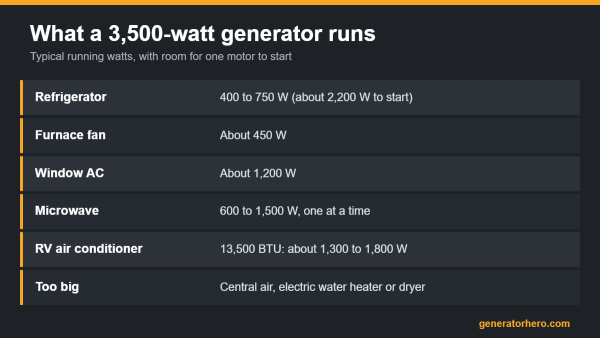
A 3,500-watt generator can run a refrigerator, a furnace fan, lights, a TV, phone chargers and a microwave (one at a time) during a power outage, or a 13,500 BTU RV air conditioner plus a few small loads at the campsite. It usually can’t handle central air, an electric water heater, an electric dryer, or a well pump and sump pump starting at the same time. The key is to add up running watts and leave room for the extra surge when a motor starts.
Running watts vs. starting watts
Every generator has two ratings:
- Running (rated) watts: what it can supply continuously.
- Starting (surge or peak) watts: the extra it can supply for a few seconds when a motor starts.
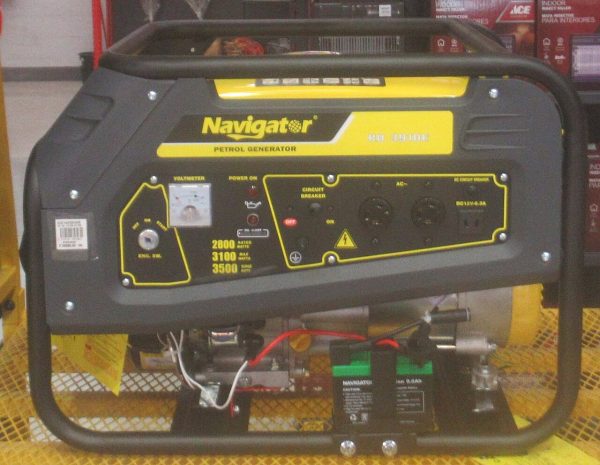
Appliances with motors or compressors, like refrigerators, pumps and air conditioners, need two to three times their running watts for a moment when they start. A generator sold as “3,500 watts” may mean 3,500 starting watts with only about 3,000 running watts, so check the spec sheet.
How many watts common appliances use
These are typical estimates from Champion Power Equipment’s wattage chart and DTE Energy’s appliance usage guide. Your appliance’s label is the best source.
| Appliance | Running watts | Starting watts | On 3,500 W? |
|---|---|---|---|
| Refrigerator/freezer | 400 to 750 | About 2,200 | Yes |
| Furnace fan (1/3 HP) | 450 | About 1,350 | Yes |
| Sump pump (1/2 HP) | 1,000 | About 3,000 | Yes, but not while other motors start |
| Window air conditioner | 1,200 | About 2,000 | Yes |
| Microwave | 600 to 1,500 | Same | Yes |
| Coffee maker | 800 | Same | Yes |
| LED TV | 80 to 400 | Same | Yes |
| Lights | 40 to 150 per fixture | Same | Yes |
| Space heater | 500 to 1,500 | Same | Yes, with little else |
| Electric water heater | 4,500 to 5,000 | Same | No |
| Central air (3 ton) | About 6,000 | Much higher | No |
How to figure out what you can run
- List what you want to run at the same time and add up the running watts.
- Find the appliance with the biggest starting surge. Add its extra starting watts (starting minus running) to your total.
- Compare. The running total must stay under the generator’s running watts, and the total with the surge must stay under its starting watts.
- Start the biggest motor first, then add smaller loads one at a time.
Example: a power outage at home
| Item | Running watts |
|---|---|
| Refrigerator | 750 |
| Furnace fan (gas furnace) | 450 |
| A few LED lights | 100 |
| TV | 150 |
| Phone and laptop chargers | 100 |
| Total running | 1,550 |
| Plus fridge startup surge (2,250 minus 750) | +1,500 |
| Peak | 3,050 |
That fits a 3,500-watt generator with a little room to spare, and you can run the microwave or coffee maker in between. Adding a 1/2 HP sump pump changes things: it adds 1,000 running watts, and its 3,000-watt startup can push you past the limit if the fridge kicks on at the same moment. Turn off other loads while the sump pump cycles, or step up to a bigger generator. A gas generator with enough capacity won’t harm your fridge. Here’s more on whether a generator can damage a refrigerator.
Can a 3,500-watt generator run an RV air conditioner?
Usually, yes. A 13,500 BTU rooftop AC typically needs about 1,300 to 1,800 running watts and more to start, so a 3,500-watt generator can run it along with the fridge, lights and a few small loads. Avoid running the microwave or a hair dryer at the same moment the AC compressor starts. A soft-start device on the AC lowers the startup surge. For 50-amp RVs with two AC units, you’ll need more power. If you have two smaller inverter generators, you can connect them in parallel.
Can it power tools on a job site?
Yes, for one or two tools at a time. Champion lists a circular saw at about 1,500 running watts (2,000 starting), a table saw at 1,800 running watts (2,500 starting) and a corded drill at 600 watts. A 3,500-watt generator can run a saw plus a drill or work light, but not two saws starting at once.
What a 3,500-watt generator can’t run
- Central air conditioning or a heat pump
- An electric water heater, electric range or electric dryer (these also need 240 volts)
- A deep well pump and a sump pump starting together
For whole-house backup, see what a 7,500-watt generator can run and how to hook a generator up to your house. If you just need a little power, see what a 2,000-watt generator can do. To compare current models, browse portable generators at Ace Hardware. (We may earn a commission if you buy through this link.)
Related guides: What can a 10,000-watt generator run, Generators & Medical Devices and Smallest Gas Generators You Can Buy.
FAQ
Will a 3,500-watt generator run a refrigerator and a freezer?
Usually, yes, as long as they don’t both start at the exact same moment along with other big loads. Plug in one, let it start, then plug in the other.
How long will a 3,500-watt generator run on a tank of gas?
It depends on the tank size and the load. Many models run roughly 8 to 12 hours at a quarter to half load. Check your model’s spec sheet.
Is 3,500 watts enough to run a house?
It’s enough for the essentials if you manage the load, but not for central air, electric heat or other big 240-volt appliances.